
2012年5月29日 星期二


2012年5月27日 星期日
2012年5月26日 星期六

2012年5月24日 星期四
miracles
Miracles are both
The beginning and the endings,
and so they alter the temporal order.
They are always affirmations of rebirth, which seem to go back, but really go forward.
They undo the past in the present, and thus release the future.
~ A Course In Miracles via The Female Grail with Durga Holzhauser


2012年5月23日 星期三
10 Simple Postures That Boost Personal Performance
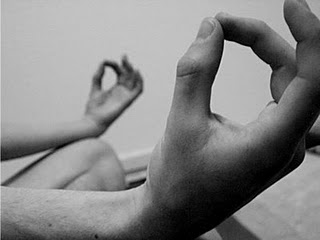
Psychological research suggests simple actions can project power, persuade others, increase empathy, boost cognitive performance and more.
We tend to think of body language as something that expresses our internal states to the outside world. But it also works the other way around: the position of our body also influences our mind.
As the following psychological research shows, how we move can drive both thoughts and feelings and this can boost performance.
1. Pose for power
If you want to feel more powerful then adopt a powerful posture. Carney et al. (2010) found that when people stood or sat in powerful poses for one minute—those involving open limbs and expansive gestures—they not only felt more powerful but had increased levels of testosterone flooding their systems. Powerful poses take up more space, so spread your body and open up the arms or legs. When you dominate the space, your mind gets the message.
2. Tense up for willpower
Tensing up your muscles can help increase your willpower. In a series of 5 studies Hung and Labroo (2011) found that when people firmed up their muscles they were better able to withstand pain, resist tempting food, take an unpleasant medicine and pay attention to disturbing information. So, if you need to increase your willpower, tense your muscles. It should help.
3. Cross arms for persistence
If you’re stuck on a problem which needs persistence then try crossing your arms. Friedman and Elliot (2008) had participants do just that and found they worked longer at a set of difficult anagrams. In fact about twice as long. Their persistence led to more correct solutions.
4. Lie down for insight
If crossing your arms doesn’t work then try lying down. When Lipnicki and Byrne (2005) had anagram solvers lying down, they solved them faster. Since anagrams are a type of insight problem, lying down may help you reach creative solutions.
5. Nap for performance
While you’re lying down, why not have a nap? Napping is an art-form though. Nap too long and you’ll suffer from sleep inertia: the feeling of being drowsy for an extended period. Nap too little and there’s no point. Where’s the sweet spot?
Brooks & Lack (2005) compared 5, 10, 20 and 30 minute naps to find the best length. For increased cognitive performance, vigour and wakefulness, the best naps were 10 minutes long. Benefits were seen immediately after 10 minute naps but after longer naps it took longer to wake up. Five minute naps only provided half the benefit, but were better than nothing.
6. Gesture for persuasion
The way people’s hands cut through the air while they talk is fascinating. But it’s more than just a by-product of communication. Maricchiolo et al. (2008) found that hand-gestures help increase the power of a persuasive message when compared to no use of gesture. Most effective are gestures which make what you are saying more understandable. For example, when referring to the past, point behind you.
7. And gesture for understanding
Gestures aren’t only helpful for persuading others, they also help us think. In a study of children, Cook et al. (2007) found that children who were encouraged to gesture while learning, retained more of what they learnt. Moving our hands may help us learn; more generally we actually seem to think with our hands.
8. Smile for happiness
The very act of smiling can make you feel happy, whether it’s justified or not. Strack et al. (1988) had participants holding pens in their mouths either so that it activated the muscles responsible for smiling, or not. Those whose smiling muscles were activated rated cartoons as funnier than others whose smiling muscles weren’t activated by the pen in their mouth. So, forcing a smile really does make us see the world in a better light.
9. Mimic to empathise
If you want to get inside someone’s head, you can try copying their behaviour. Those who are good at empathising do it automatically: copying accent, posture, expressions and so on. If you can copy it, you will feel it yourself and then you’ll get a hint of what others are feeling. It’s what actors have known for years: mimicry is a great way of simulating others’ emotional states.
10. Imitate to comprehend
The idea that copying helps us understand others works for thought as well as emotion. In an experiment by Adank (2010), participants found it easier to decipher an unfamiliar accent if they tried to imitate it themselves. Some psychologists go further, claiming that imitating others helps us predict what they are going to do (e.g. Pickering & Garrod, 2007).
Embodied cognition
Many of these studies support a theory about human life (and indeed all life) called ‘embodied cognition’. The idea is that we don’t just think with our minds, we also think with our bodies. Our mind isn’t a brain in a jar, it is connected to a body which moves around in an environment.
As life becomes increasingly virtual, played out on screens of varying sizes, we need reminding that the connection between mind and body is two-way. Human intelligence is more than abstract processing power; it’s about the interaction between mind, body and the world around us.
http://wakeup-world.com/2011/08/05/10-simple-postures-that-boost-personal-performance/
2012年5月20日 星期日
2012年5月18日 星期五


2012年5月16日 星期三
imagination

Generally speaking, a howling wilderness does not howl: it is the imagination of the traveler that does the howling
~ Henry David Thoreau
Photograph: Terje Sorgjerd

2012年5月15日 星期二
unseen world
Everything you see has its roots in the unseen world.
The forms may change, yet the essence remains the same.
Every wonderful sight will vanish, every sweet word will fade,
But do not be disheartened,
The source they come from is eternal, growing,
Branching out, giving new life and new joy.
Why do you weep?
The source is within you
And this whole world is springing up from it.
-Rumi
The forms may change, yet the essence remains the same.
Every wonderful sight will vanish, every sweet word will fade,
But do not be disheartened,
The source they come from is eternal, growing,
Branching out, giving new life and new joy.
Why do you weep?
The source is within you
And this whole world is springing up from it.
-Rumi
2012年5月14日 星期一
Remembering
 No need to work hard at integrating ourselves
 The infinite Universe lies in each particle of our being
We just temporarily forgot that there is no separation between us and ALL that is
~~Sherryl Frauenglass, A woman's true voice
We are remembering.


2012年5月12日 星期六
drawing mental illness
http://www.brainpickings.org/index.php/2012/01/04/bobby-baker-diary-drawings-mental-illness-and-me/
2012年5月9日 星期三

訂閱:
意見 (Atom)